
It feels like lately every networking event, LinkedIn post and business conversation eventually ends up talking about AI.
A lot of people think it’s the future.
For others it feels like a threat.
Most small business owners are somewhere in the middle—wondering whether they’re already being left behind.
The problem isn’t whether to use AI in your small business. It’s how you use AI without losing the human touch that makes your business successful in the first place.
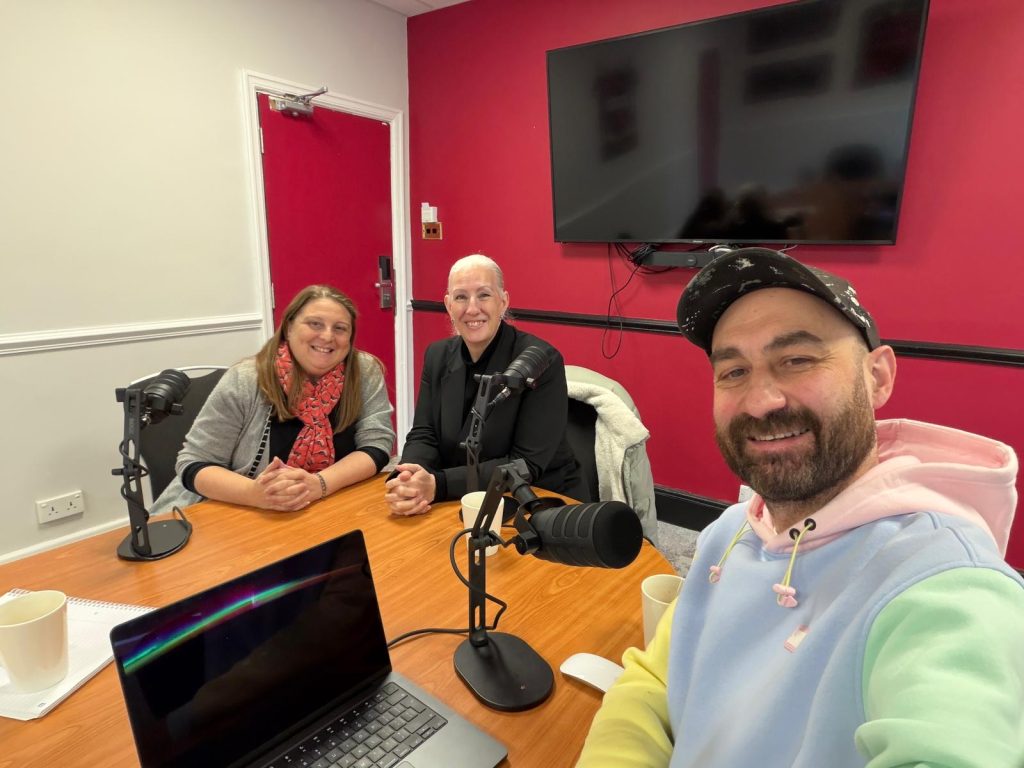
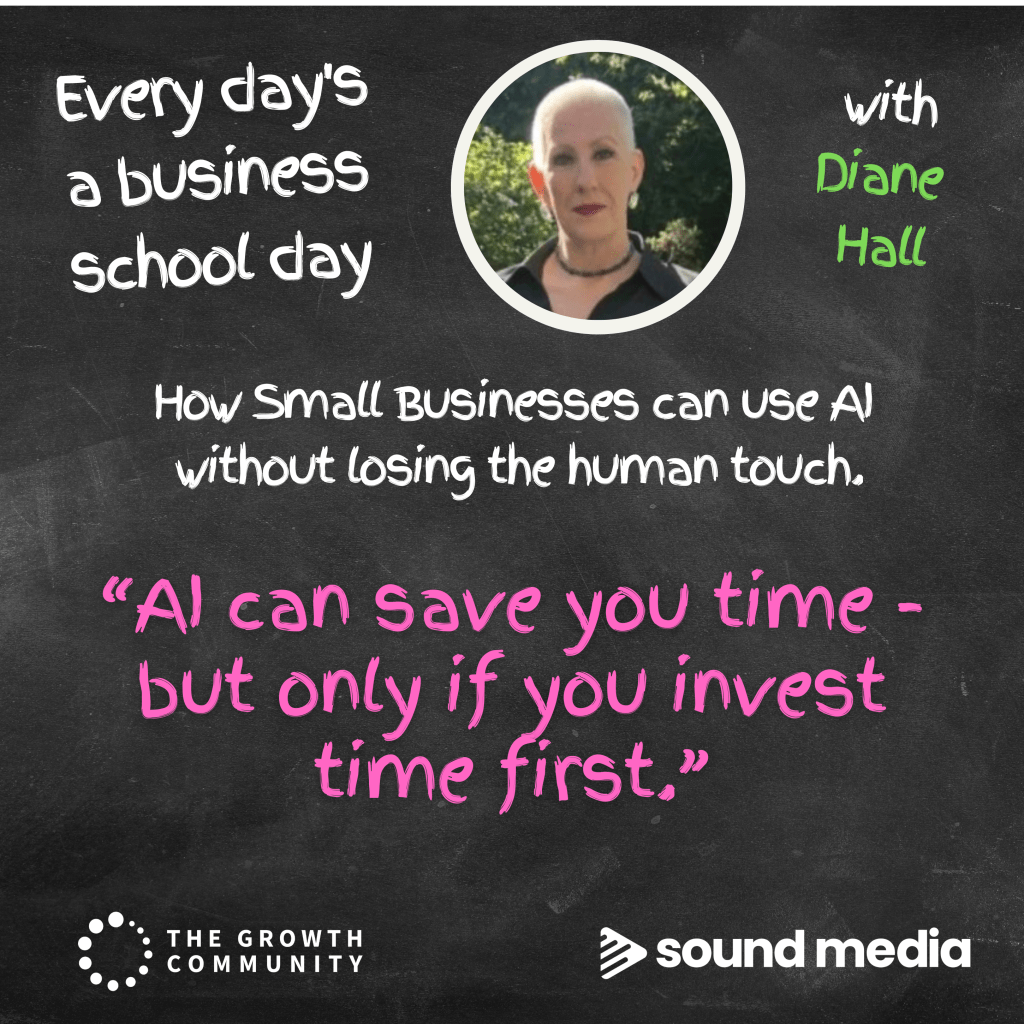
In Season Three of the ‘Everyday’s A Business School Day’ podcast, Nicky Thomas (Founder of The Growth Community) and James Marriott (Podcast Expert and Founder of Sound Media) chatted to Diane Hall from Evolve3 CIC about how small businesses can get started with AI without losing their human connection.
This blog covers outputs from that podcast session (including Diane’s homework) but you can also listen to the podcast on Spotify (or wherever you like to enjoy them).

Quick Article Summary
Artificial intelligence (AI) is changing the way small businesses work—but it doesn’t have to change who you are. In this blog, we share practical take aways from our conversation with Diane Hall on how to use AI to save time, improve productivity and generate ideas in your business, whilst protecting the important stuff like relationships, personality and customer experience that make small businesses successful in the first place.
AI Isn’t Optional Anymore
In short. You can’t ignore it. It’s happening. Your competitors may already be using it.
The good news is that you don’t have to just jump in.
But, if you’re going to have a dabble with AI, it’s important to focus on how it will deliver positive results without sacrificing the very thing that makes small businesses so competitive in the first place – our human touch.
Our advice? Begin small. Try some things out that help with the heavy lifting in your business. You will be pleasantly surprised what can be achieved.
“AI is a Tool – It’s Not Magic!”
It’s easy to fall into one of two camps with AI – a ‘looming threat’ or a ‘miracle solution’.
But in reality, AI is just a really productive tool.
I am old enough to remember the dawn of the internet and how it revolutionised everything – especially business! So now, like then, it’s important to not get left behind or think it’s just a fad.
Equally though, try not to get too distracted with new shiny object syndrome either.
Before you do anything big, ask yourself,
“Why am I using AI and what benefit does it bring me, my business and my customers?”
AI is definitely not magic. In fact, it isn’t always correct! Like any other tool, you need to know how to use it effectively and safely to get the most efficient results.
Think of AI As Your Business Assistant
As an AI novice it’s best to start by keeping things simple. At this point you don’t need a complicated strategy, nor do you need to be exploring tonnes of different tools.
An easy starting point might look like:
- Asking AI to summarise information quickly
- Generating or sparking some ideas to aid your creativity
- Drafting some simple content that you can then refine and put into your own tone of voice
- Exploring some new ideas for your business or some competitor analysis
By trying AI out as a ‘capable assistant’ you’ll soon get a better handle on how to talk to it, and you’ll really enjoy how it takes some of the heavy lifting out of your day to day tasks.
Remember though, the human touch is your differentiator, so if you are using AI to draft marketing or customer focused content, don’t leave any ‘robotic’ speech in there or fall back on too many AI generated images. Your customers will notice and that’s how loss of trust starts to creep in.
Small businesses have always competed differently from large organisations.
We don’t win because we are the cheapest. We win because we are:
- Responsive
- We Care
- We remember conversations
- We build actual relationships with our customers
If you can use AI to strengthen this approach, then you are on to a winner!
AI Should Support Your Thinking – Not Replace it
AI is brilliant at speeding things up.
It can analyse, summarise and generate ideas in literally seconds – which is a total godsend to owners who often have to wear a lot of hats in their small business.
But it does have one big limitation.
As Diane puts it during the podcast: “AI doesn’t actually ‘think’. It predicts.”
So, it can give you convincing, but sometimes incorrect, answers to your questions. It will fill gaps in its analysis with assumptions. Assumptions made by a computer (not a human).
I experienced this myself while writing some marketing content.
I wondered whether a particular statistic existed, so I asked ChatGPT. Within seconds it came back with exactly the figure I was hoping for. It looked credible and I was delighted that it would support the point I wanted to make.
But something didn’t quite sit right, so I asked where it got the statistic from. That’s when ChatGPT apologised and admitted that it had contrived the numbers from a very different source. Thankfully, I didn’t just copy and paste the statistic or I’d have risked damaging trust with my audience by sharing inaccurate information.
AI is an incredibly useful assistant, but I was glad that I kept my human judgement in play and asked about the source of the information.
As Diane says: “You still need your brain switched on!”
I highly recommend that you:
- Check the facts – ask where it got the information from and check it in context
- Apply your human judgement
- Sense check the outputs.
Let AI do the monotonous work while you bring the ‘real world’ intelligence to the table. That’s how small businesses can get the most out of AI without losing their human touch.
Where AI Can Make the Biggest Difference in a Small Business
For the most part, small businesses are using AI to unlock time, take away repetitive tasks and open up greater perspective and ideas.
Here are some of the most valuable ways that small businesses can start their journey.
1. A ‘Critical Friend’ for your business
When you are doing more or less everything in your small business you can feel very close to it and gaining some outside perspective is insightful.
Try getting AI to review your website, messaging, branding or business plan ideas. You’ll be surprised how helpful it can be. And the more you spend time with your AI engine of choice, the more it gets used to your style and the way you think too. It’s a bit scary at first, but it doesn’t take long for it to feel like a useful friend who can give you some straight talk when you need it!
A couple of good questions you could ask are:
What does my business look like to a new customer?
What am I not communicating clearly?
What opportunities am I missing?
2. Idea Generation and Creativity
How often do you start with a blank page and wish for some inspiration to get you going? This is one of the simplest uses of AI that has a massive impact on small business productivity.
It’s amazing how quickly AI can unlock ideas and support your creativity.
Have a go at:
Brainstorming ideas – ask questions, challenge AI to try it in different ways
Asking for starting prompts
Digging deeper
Sharing something you are thinking about doing and getting AI to help you think differently around the topic.
3. Saving Time on Repetitive Tasks
AI is great for composing ‘first drafts’ of many different things.
Rather than wasting time trying to get started on things like blogs, emails, social media posts, newsletters etc you can get AI to have a go at getting the main points down. Then all you need to do is turn it into your ‘own’ voice and you’ve skipped through a lot of wasted time!
Never send an AI first draft to people though. The human touch is the biggest differentiator of a small business and you could undermine years of hard work by sending robotic messages to valued customers or suppliers.
4. Use AI to Make Better Business Decisions
AI is really effective at exploring scenarios, thinking through risks and helping you to weigh up your options. While it’s not an exact science it can access information at the speed of light that would take you days or even weeks to work through.
Some questions that you might like to try:
What are the pros and cons of this idea?
What could possibly go wrong?
What am I not considering?
AI can’t make your decisions for you, but it can help you be more thorough in making them yourself. And remember that AI isn’t always 100% correct, so it is prudent to check all sources.

How I Use AI to Write My Blogs
I’ve been a copywriter for 30 years and my initial reaction to AI was utter horror that people would let a computer write their messaging! But despite my initial scepticism I started to ‘have a faff” (as Diane put it in the podcast episode!)
My blogs are still very much my own work, my own experience and my own voice. Where AI helps me is behind the scenes. I use it to brainstorm ideas, challenge my thinking, tighten SEO, improve headings, spot gaps in my argument and even proofread the final draft.
In a blog like this one, where it is based on a podcast episode, AI saved me masses of time. Instead of listening to the episode several times, making notes and then pouring over the transcript to find the ‘pullout’ quotes, ChatGPT did the heavy lifting. It gave me more time to spend on coming up with the overall theme and adding my own experience and thoughts.
It never replaces my writing—it simply helps me produce better content more efficiently.
Sometimes the hardest part of writing is the ‘getting started’ part. AI gets me past the blank page. It actually gives me time back in the ‘boring’ places so that I can enjoy writing even more content than I was previously!
Essentially, as Diane described, it is my ‘critical friend’. It doesn’t replace my experience, knowledge or voice. It organises my thoughts more efficiently and enables my finished blog to work harder out there in the SEO world!
Don’t Let AI Take Away Your Biggest Competitive Advantage
Remaining competitive whilst still maintaining the human touch is a constant juggle for small businesses. But it’s the stuff that doesn’t scale that makes us who we are. So, while you’re experimenting with AI, don’t lose sight of the customer experience. Because that is your biggest competitive advantage.
Relationships matter. Trust matters. Experience matters.
If your customers can’t interact with you or get answers and they feel like they are dealing with a machine – you’ll be no better than the lazy big guys!
As Diane explains it in the podcast: “AI should underpin humans, not replace them.”
Be Careful What You Trust and What You Share
AI is not infallible. It’s very good at sounding confident in its outputs but it doesn’t always understand the context. Always check for accuracy – especially statistics and legal information.
Have common sense about data you input into an AI engine. Avoid client or sensitive information. Be generic wherever possible.
How to Start Using AI in Your Business Today
As is customary in the Everyday’s A Business School Day Podcast, we asked Diane to set a piece of homework for our listeners.
Her biggest piece of advice wasn’t to buy expensive software or go on a course. It was simply to “have a faff”.
Open ChatGPT.
Ask it something.
Play.
A simple way to stop procrastinating and just have a go.
How AI Can Make Small Businesses More Efficient (Without Losing Their Human Touch)
All in all I think the key takeaways from our conversation with Diane are this:
AI isn’t here to replace you or your business.
It’s here to help you run it better.
It can save you time, spark ideas and challenge your thinking.
It can be your critical friend and help you improve your customer experience and communication.
AI will continue to evolve.
New tools will appear almost weekly.
But one thing is unlikely to change.
Your customers will still buy from people they know, like and trust.
So embrace AI.
Experiment.
Have a faff.
Use AI to save time. Use it to think differently. Use it to challenge your ideas.
But never lose the human touch, personality and relationships that made your small business so successful in the first place.

AI FAQs
Should small businesses be using AI?
Yes—but with purpose.
AI can save time, generate ideas, improve productivity and support better decision-making. However, it works best when it’s used to enhance your skills rather than replace them. The businesses that will benefit most are those that combine AI with human experience, judgement and excellent customer service.
How can I start using AI in my small business?
The simplest way to start is by experimenting with one or two everyday tasks.
For example, try using AI to:
- summarise documents
- brainstorm ideas
- draft emails or social media posts
- review your website from a customer’s perspective
- analyse competitors
As Diane Hall says in the podcast, don’t overcomplicate it—just “have a faff.” The more you experiment, the more confident you’ll become.
What are the best AI tools for small businesses?
There’s no single “best” AI tool because every business is different.
For many small business owners, ChatGPT, Claude, CoPilot or Gemini are excellent starting points because they are easy to use and incredibly versatile. Once you’re comfortable, you can explore more specialist tools for design, marketing, research or automation.
The important thing isn’t finding the perfect tool—it’s finding one that helps you save time and work more effectively.
Can AI improve productivity in a small business?
Absolutely.
AI is particularly good at reducing the time spent on repetitive or administrative tasks. It can help you draft content, summarise information, brainstorm ideas and analyse data much faster than doing everything manually.
The time you save can then be spent on the parts of your business that AI can’t replace—building relationships, serving customers and growing your business.
Can AI replace people in a small business?
AI shouldn’t replace people—it should support them.
One of the strongest messages from our conversation with Diane Hall was that AI should underpin humans, not replace them. Small businesses succeed because of their relationships, trust and personal service. AI can improve efficiency, but it should never come at the expense of the customer experience.
What are the risks of using AI in business?
The biggest risk is assuming that AI is always right.
AI can confidently produce inaccurate information, so it’s important to check facts, verify sources and apply your own judgement before using any content or advice it generates.
It’s also essential to avoid sharing sensitive customer or confidential business information with AI tools unless you’re confident about how that data is being handled.growth, audience and positioning.
Further Resources
This blog is based on an episode which is part of Season Three of Everyday’s A Business School Day podcast. You can listen to move episodes on Spotify or wherever you like to listen to podcasts.
Why not have a read of some of our other blogs in our library.
Identify the right networking format for you
Decide if networking groups are worth the effort
How to get the most out of your 121s
Ways you can build trust with your connections
Learn more about Growth Community member only meetings
Why member only meetings add value to membership
Try some Growth Community relaxed but very purposeful networking?
Find a location that suits you. And don’t forget you can visit us up to SIX time a year for free!


